-This problem is about graphing logarithmic equations: finding key points, x/y intercepts, range, and asymptote.
- When graphing these type of equations, the reader must understand that when graphing, the asymptote will lie on the x-axis. Also the range is always infinite.
-This problem is about graphing exponential functions: finding key points, x/y intercepts, domain, range, and asymptote.
-In order to avoid establishing conflict when solving this problem, one must understand that when graphing exponential functions, the asymptote will lie on the y axis.
What is the difference between a graph having a vertical asymptote and a graph having a hole?
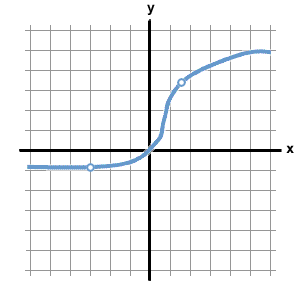
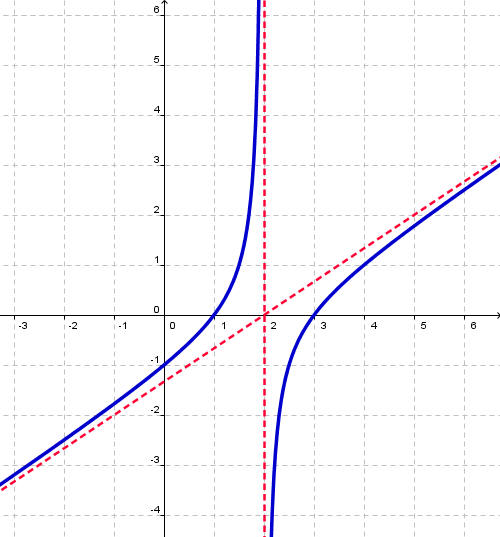
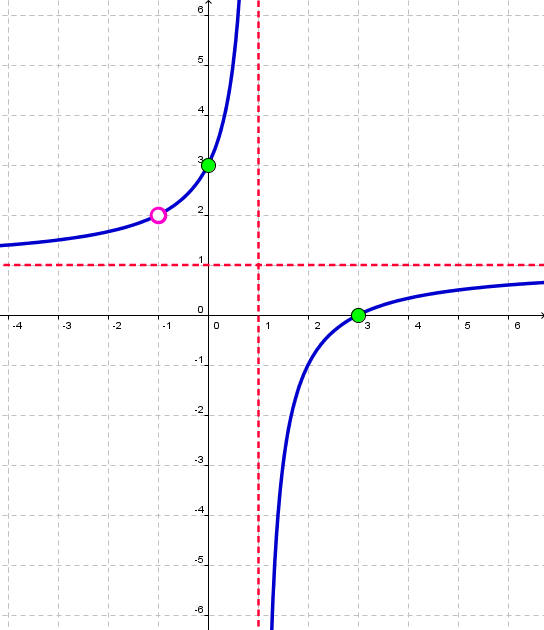
Vertical asymptotes and a graph having a hole is different. Holes are values along the points of a line that do not exist for a specific value. Vertical asymptote is a line where a graph will go toward but never reach. To find a vertical asymptote, we must first simplify the rational function, and set the denominator to zero. To find a hole, we must cross out factors that cancel and use those to find our holes.
Describe how to find the x-intercepts of a rational function. Include both the long way and the shortcut way, explaining why the shortcut makes mathematical sense.
To find the x-intercepts of a rational function we must first simplify the equation and then we must set the y equivalent to 0. Once we do that, we can multiply the denominator to both sides, and that will cancel out. Once we are left with the numerators, we are able to solve for x, giving us the x-intercepts. The shortcut way is just setting the numerator to zeroes and solving for x.
How do we find the appropriate place to plot a hole if the y-value is undefined when plugged into the original equation. If the y-value is undefined when plugged in the original equation we must take another step to avoid that problem. What we do is we must simplify the equation and then plug in 0 to find the appropriate plots for the hole.