Create your own Playlist on MentorMob!
Wednesday, December 12, 2012

Monday, December 10, 2012
Wednesday, November 28, 2012
Unit K Concept 10: Student Problem 7

What is this problem about?
- This problem is about repeating decimals.
- In this problem, I demonstrate how to convert a repeating decimal in to a ratio for a geometric sequence/series.
What does the viewer need to pay special attention to in order to understand the concept?
- The reader must understand why we use each step.
- First we split it up in to a series, and then we find the ratio.
- The ratio will help us determine whether it converges or not, most of the time the ratio is less than one, and it should converge since decimals are always less than one.
- The summation should be infinite, meaning there are an infinite amount of possibilities instead of one constant summation.
Fibonacci Haiku (Basketball)
Fibonacci Haiku "Basketball"
Basketball,
Shoes,
point guard,
Pick and roll.
The game is quite complex.
Before you start running, make your muscles stretch.

Sunday, November 4, 2012
Student Problem 6: Unit J Concept 6


- This Problem is about decomposing partial fractions with repeated factors. Instead of having two constants, we can have a numerous amount. In this problem I demonstrate how to decompose a partial fraction with a cubed denominator.
- When solving we must be careful not to mess up the numerators. Also, in our solution we have a 0 as a numerator and that will be equivalent to nothing so there is no need to write it as our answer.
Student Problem 5: Unit J Concept 5


- This problem is about decomposing distinct factors. In this problem we are taking the equation and breaking it down into a decomposed fraction.
- The reader must understand that when splitting these fractions, we must have a constant as the numerator's position. When we finish solving, our constants will be substituted creating our decomposed fraction.
Monday, October 22, 2012
Student Problem 4: Unit I Concept 2

- When graphing these type of equations, the reader must understand that when graphing, the asymptote will lie on the x-axis. Also the range is always infinite.
Sunday, October 21, 2012
Student Problem 3: Unit I Concept 1

-In order to avoid establishing conflict when solving this problem, one must understand that when graphing exponential functions, the asymptote will lie on the y axis.
Friday, October 19, 2012
Friday, October 12, 2012
Unit H Concept 7 Student Video
- In this video we teach you how to reduce a logarithmic equation to match its clues.
- We will explain why the question will become that answer.
Sunday, September 30, 2012
Unit G Summary Question #4: Vertical Asymptote vs. Holes
What is the difference between a graph having a vertical asymptote and a graph having a hole?
Vertical asymptotes and a graph having a hole is different. Holes are values along the points of a line that do not exist for a specific value. Vertical asymptote is a line where a graph will go toward but never reach. To find a vertical asymptote, we must first simplify the rational function, and set the denominator to zero. To find a hole, we must cross out factors that cancel and use those to find our holes.
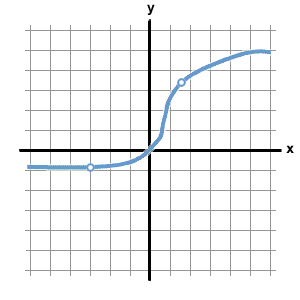
Vertical asymptotes and a graph having a hole is different. Holes are values along the points of a line that do not exist for a specific value. Vertical asymptote is a line where a graph will go toward but never reach. To find a vertical asymptote, we must first simplify the rational function, and set the denominator to zero. To find a hole, we must cross out factors that cancel and use those to find our holes.
Unit G Summary Question #9: x-intercepts
Describe how to find the x-intercepts of a rational function. Include both the long way and the shortcut way, explaining why the shortcut makes mathematical sense.
To find the x-intercepts of a rational function we must first simplify the equation and then we must set the y equivalent to 0. Once we do that, we can multiply the denominator to both sides, and that will cancel out. Once we are left with the numerators, we are able to solve for x, giving us the x-intercepts. The shortcut way is just setting the numerator to zeroes and solving for x.
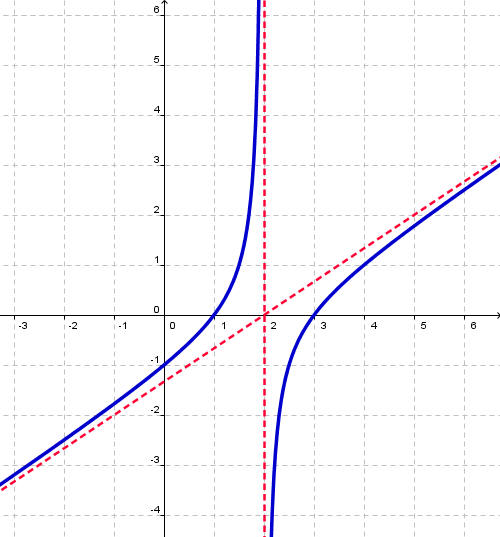
To find the x-intercepts of a rational function we must first simplify the equation and then we must set the y equivalent to 0. Once we do that, we can multiply the denominator to both sides, and that will cancel out. Once we are left with the numerators, we are able to solve for x, giving us the x-intercepts. The shortcut way is just setting the numerator to zeroes and solving for x.
Friday, September 28, 2012
Unit G Summary Question #6: Hole
How do we find the appropriate place to plot a hole if the y-value is undefined when plugged into the original equation.
If the y-value is undefined when plugged in the original equation we must take another step to avoid that problem. What we do is we must simplify the equation and then plug in 0 to find the appropriate plots for the hole.
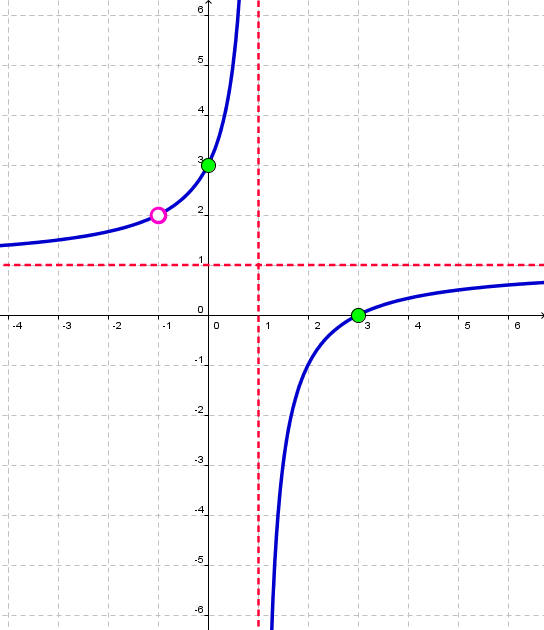
If the y-value is undefined when plugged in the original equation we must take another step to avoid that problem. What we do is we must simplify the equation and then plug in 0 to find the appropriate plots for the hole.
Wednesday, September 26, 2012
STUDENT VIDEO #1: Unit F Concept 10
- This video teaches us how to find the complete factorization and zeroes of this equation
- Pay attention to the steps we go through to find our answers!
Unit G Summary Question #8: Y-Intercept
How do you find the y-intercept of a rational function? Does this need to be done in the original or simplified equation?
To find the y-intercept of a rational function, we substitute all the 'x' values with 0's. It is not necessary to do this when the rational function is simplified, although it would make it a lot easier. It can either be done in the original or simplified.
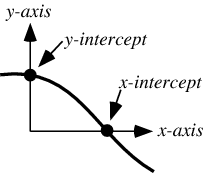
To find the y-intercept of a rational function, we substitute all the 'x' values with 0's. It is not necessary to do this when the rational function is simplified, although it would make it a lot easier. It can either be done in the original or simplified.
Unit G Summary Question #10: Range of Rational Function
While the domain of a rational function depends on DIVAH, what do you think the range of a rational function depends on?
If the domain of a rational function depends on vertical asymptotes and holes, which are 'bad values', then the range of a rational function must depend on the bad y values. We find the domain by setting denominator equivalent to 0, and there it will give us our x restrictions, the range of a rational function will probably be dependent on the y value restrictions.

If the domain of a rational function depends on vertical asymptotes and holes, which are 'bad values', then the range of a rational function must depend on the bad y values. We find the domain by setting denominator equivalent to 0, and there it will give us our x restrictions, the range of a rational function will probably be dependent on the y value restrictions.
Unit G Summary Question #5: Graph Crossing Asymptote
Describe the conditions in which a graph can cross through an asymptote.
The graph will cross through the asymptote only if it is horizontal or slant. A vertical asymptote is one where the graph will NEVER touch with. In horizontal or slant asymptotes, the graph will slightly touch in the middle and never to the far left or right.
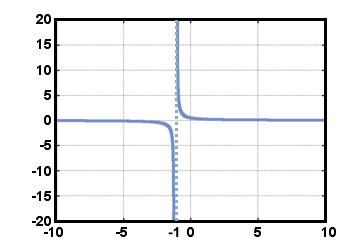
The graph will cross through the asymptote only if it is horizontal or slant. A vertical asymptote is one where the graph will NEVER touch with. In horizontal or slant asymptotes, the graph will slightly touch in the middle and never to the far left or right.
Tuesday, September 25, 2012
Unit G Summary Question #2: Limit Notation (Horizontal Asymptote)
Describe what limit notation for horizontal asymptotes actually means.
Limit notation for horizontal asymptotes is very similar to limit notation for vertical asymptotes. The only difference in setting up limit notation is, we have to write it as x approaches infinity or -infinity, f(x) will reach a certain number. This is due to the fact that we are looking for the horizontal asymptote and not vertical. Limit notation for horizontal actually means that when x is reaching infinity or negative infinity f(x) will be reaching a certain number. The 'y' in this case will forever be equivalent to 0.

Limit notation for horizontal asymptotes is very similar to limit notation for vertical asymptotes. The only difference in setting up limit notation is, we have to write it as x approaches infinity or -infinity, f(x) will reach a certain number. This is due to the fact that we are looking for the horizontal asymptote and not vertical. Limit notation for horizontal actually means that when x is reaching infinity or negative infinity f(x) will be reaching a certain number. The 'y' in this case will forever be equivalent to 0.
Unit G Summary Question #3: Slant Asymptote
When does the graph have a slant asymptote? How can you find the equation of a slant asymptote?
We are able to determine whether the graph has a slant asymptote when the degree of the equation is bigger on top by one. To find the equation of a slant asymptote, we will be using long division. Once we do this step, the answer should be in slope intercept form, and we are able to graph our slant asymptote.
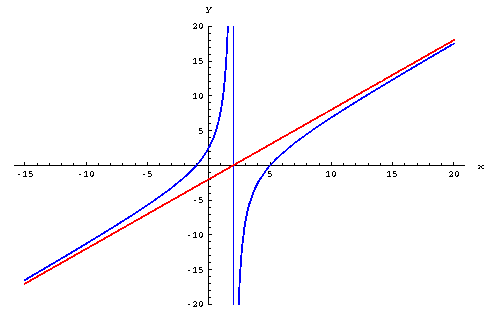
We are able to determine whether the graph has a slant asymptote when the degree of the equation is bigger on top by one. To find the equation of a slant asymptote, we will be using long division. Once we do this step, the answer should be in slope intercept form, and we are able to graph our slant asymptote.
Unit G Summary Question #7: Limit Notation (Vertical Asymptotes)
Describe how to write limit notation for vertical asymptotes and what the notation means.
To write out limit notation, we must first determine the vertical asymptotes. Basically, limit notations for vertical asymptotes will determine which direction the graph will go toward when going to the vertical asymptote. For example, if vertical asymptotes were -1 or 1, we would write our limit notation as x approaches -1 + or - (the plus or negative means right or left) the graph would either go toward infinity or negative infinity, and that is how we write limit notation for vertical asymptotes. The notation will determine whether the graph will head toward infinity or negative infinity.

To write out limit notation, we must first determine the vertical asymptotes. Basically, limit notations for vertical asymptotes will determine which direction the graph will go toward when going to the vertical asymptote. For example, if vertical asymptotes were -1 or 1, we would write our limit notation as x approaches -1 + or - (the plus or negative means right or left) the graph would either go toward infinity or negative infinity, and that is how we write limit notation for vertical asymptotes. The notation will determine whether the graph will head toward infinity or negative infinity.
Monday, September 24, 2012
Unit G Summary Question #1: Horizontal Asymptote
1. How do we know if a graph has a horizontal asymptote? What are three options?
We can tell if it is a horizontal asymptote if we compare degrees. If the bigger degree is on bottom and that will allow the asymptote to be y=0. If it is the same degree, the asymptote is the ratio of the coefficients. If it is a bigger degree on top, there is no horizontal asymptote.
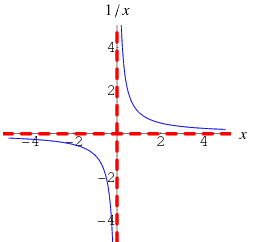
We can tell if it is a horizontal asymptote if we compare degrees. If the bigger degree is on bottom and that will allow the asymptote to be y=0. If it is the same degree, the asymptote is the ratio of the coefficients. If it is a bigger degree on top, there is no horizontal asymptote.
Subscribe to:
Posts (Atom)