1. How have you performed on the Unit O and P tests? What evidence do you have from your work in the unit that supports your test grade (good or bad)? Be specific and include a minimum of three pieces of evidence.
On the Unit O Test, I feel like I did extremely well until I got the test results back. I made extremely minor mistakes. As I prepared for the retake, I didn't feel like any of the work I did was necessary. I retook the test and got a way higher score from learning from my mistakes. Overall, I felt like my test grade was very good for the Unit. For Unit P, my test grade was actually better than I expected. For this test I really gambled my luck. I got an 85 expecting to get something way lower. My quiz scores demonstrated that I made minor mistakes as well and fixed them on the assessment.
2. You are able to learn material in a variety of ways in Math Analysis. It generally follows this pattern:
→ Your initial source of information is generally the video lessons and SSS packets followed by a processing and reflection activity via the WSQ
→ individual supplemental research online or in the textbook before class
→ reviewing and accessing supplementary resources provided by Mrs. Kirch on the blog
→ discussion with classmates about key concepts
→ practice of math concepts through PQs
→ formatively assessing your progress through concept quizzes
→ cumulatively reviewing material through PTs
→ Final Assessment via Unit Test.
Talk through each of the steps given in the following terms:
a. How seriously do you take this step for your learning? What evidence do you have to support your claim? Make sure to make reference to all 8 steps.
b. How could you improve your focus and attention on this step to improve your mastery of the material? What specific next steps would this entail? Make sure to make reference to all 8 steps.
The first step I take very seriously. I try to focus as much as I can to learn the material that I need to. I don't know how to improve my focus but I already try my best. For the second step, I do not take seriously at all. I feel like that is not necessary, I only use the videos and the packet. Same with step three and four. I try to do my PQs as much as I can until I feel very confident. The quizzes are pretty much a simulation of the test so try to take them seriously as well, If I feel like I am not confident, I would know what to study before the test day. For the test, I take my time and go over each problem slowly and this sometimes leads to conflict because the bell rings and I run out of time.
3. Reflect on your learning this year thus far by considering the following questions:
a. How confident do you generally feel on the day of a Unit Test? Give evidence and specifics to back up your answer.
b. How well do you feel you have learned the math material this year as compared to your previous years in math? Give evidence to support your claim.
c. How DEEPLY do you feel you have learned the math material this year as compared to your previous years in math? Give evidence to support your claim.
d. Do you normally feel like you understand the WHY behind the math and not just the WHAT/HOW? Meaning, do you understand why things work, how they are connected to each other, etc, and not just the procedures? Explain your answer in detail and cite specific evidence from this year.
e. How does your work ethic relate to your performance and success? What is the value of work ethic in real life?
On the day of the test, I feel somewhat confident. Realistically, the test is always intimidating, however I have learned to conquer my enemies, and step on the field as I if I am always going to conquer. Starting off with the first test in semester 2, I always circle the A+ on the corner of my test, believing that I would get that. Realistically I never earn the perfect score but I always earn a score that is fairly close to that. One time I did not circle the letter grade I predicted to get at all and I got a C, which was very coincidental, but now on every test it is like a ritual for me to circle A+. I feel like this year of math I have learned WAY more than last year. I feel like this class is more organized than any of my other classes from previous years. In my opinion, the practice quizzes help a lot. If I get something wrong, I can learn from my mistakes and never make that same mistake again on the test. I feel like the PQ, and PT Fall under the same category, and are just there for practice. Math this year has help me to understand why something happens in math. It is not just the procedure anymore, but the reasoning behind it. By deriving formulas from triangle, it has helped me understand that all these formulas do not simply pop up from the shadows. My work ethic is very inconsistent. There are weeks were I try very hard, and then there are weeks where I am so tired from how hard I've been trying. However, after the many months of junior year, I've started to prioritize math over my other classes. Work ethic is very important in real life. One slip off the track and it could be possible to never get back on. It is important to stay consistent through the whole year no matter how hard it is, it will eventually pay off. As of right now, I am currently trying my best to practice what I preach. I am still young and learning and math analysis this year has taught me a lot.
Monday, March 18, 2013

Thursday, March 7, 2013
WPP #14 Unit P Concept 7
- This concept incorporates law of cosines in word problems
- Listen carefully as I demonstrate how to find sides and angles using the law of cosines
WPP #13 Unit P Concept 6
- This is about incorporating law of sines in word problems
- Watch carefully as I find the missing angles and sides of the triangle.
Sunday, February 24, 2013
WPP #12 Unit O Concept 10
Create your own Playlist on MentorMob!
This video is about translating word problems in math.
Watch closely as a explain how to use trig functions to find the missing sides of a triangle.
This video is about translating word problems in math.
Watch closely as a explain how to use trig functions to find the missing sides of a triangle.
WPP #11 Unit O Concept 9
Create your own Playlist on MentorMob!
This video explains to you how to use the Pythagorean theorem.
Pay attention as I translate the word problem in to a 2d visualization.
This video explains to you how to use the Pythagorean theorem.
Pay attention as I translate the word problem in to a 2d visualization.
Tuesday, February 12, 2013
Unit N Concept 7: Derive the Unit Circle
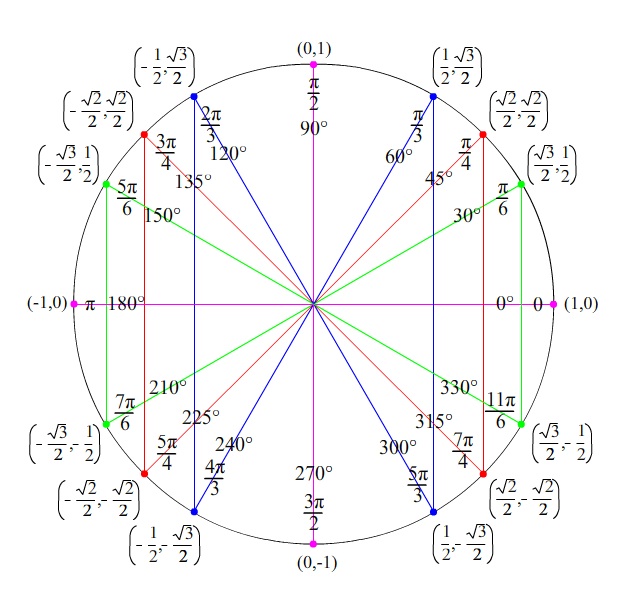
Triangle #1
 As we can see this triangle is formed by creating a 30 degree angle. To find our point on the circle, we must know the rules of these special right triangles. Each side of a triangle is labeled with a missing variable. For example, for this special right triangle, the hypotenuse is equivalent to 2n, the shortest side of the triangle is equivalent to n, and the longest side before the hypotenuse equals n radical 3. All we need to do is find the lengths of x and y of the triangle. All we have to do is set the hypotenuse (2n) equal to 1 and we can solve from there on. work is shown below.
Triangle #2
 The next special right triangle is created by a 45 degree angle. What we must know is that for this triangle the hypotenuse is equivalent to n radical 2, and the the two other sides are equivalent to n. Again all we must do is set the hypotenuse equal to 1 and solve. From there we can get the lengths of x and y, and eventually our point on the circle.
Triangle #3
 For this special right triangle, we can see that it is pretty much the same as the first triangle. Once we do this last one we can see that we have found three coordinates, and these coordinates correspond on a unit circle. This occurs throughout the unit circle except in the other quadrants we must face the signs of the coordinates. We can see that these three points are the same throughout the unit circle and how it relates to it.
Friday, February 1, 2013
Conic Section (Ellipse)
Conic Section
(Parabola)
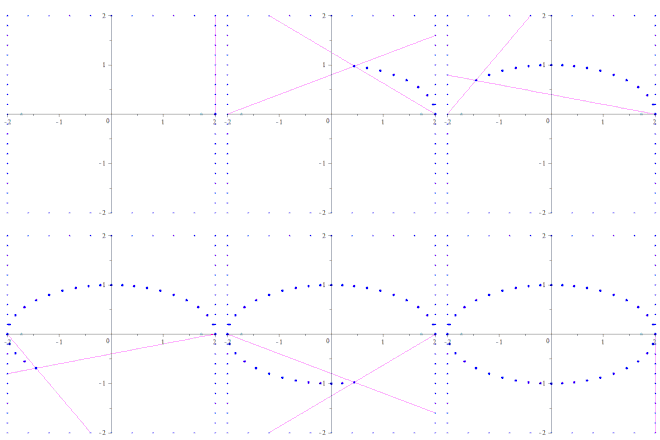
Q #1: What is the mathematical definition of this conic section and how does that definition play a role in the properties of the conic section and how it is shaped or formed?
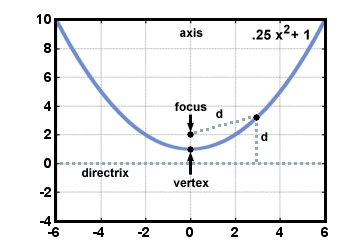

A #1: A parabola consists of a focus point, and a directrix. The focus is just a point inside the parabola, and the directrix is a fixed line beneath the parabola to help draw the curve. We can see that the length between the focus and directrix are equidistant when connected to touch the parabola. The eccentricity of a graph is usually 1. This is because if it were less, the curve would close in, and if it were greater, the parabola would eventually open wider and create a hyperbola. Click here to get a visual understanding of eccentricity.
Q #2: How does the focus (or foci) affect the shape of the conic section?
A #2: The distance of of the vertex to the focus point named as the term 'p'. The 'p' is equidistant to the length of the directrix connected to the graph. The distance of the focus and directrix to the vertex can fluctuate the size of the parabola. If the focus and directrix were farther away from the vertex, the graph would open much wider, otherwise it would be very thin. Click here to experiment with a live parabola.
Q #3: How do the properties of this conic section apply in real life?
A #3: Here we can see that the cables of the S.F.G.G. Bridge is very close to a parabola. It is shaped this way because the two towers holding the cables are very close to each other. Therefore, the cable must equally distribute its weight from the distance of one tower to the other. The closer it is to the tower, the higher the curve. This creates the shape of a parabola.

Citation
http://www.mathsisfun.com/geometry/eccentricity.html
https://www.google.com/images
http://www.intmath.com/plane-analytic-geometry/parabola-interactive.php
Subscribe to:
Posts (Atom)