- This is about incorporating law of sines in word problems
- Watch carefully as I find the missing angles and sides of the triangle.
Thursday, March 7, 2013
WPP #13 Unit P Concept 6

Sunday, February 24, 2013
WPP #12 Unit O Concept 10
Create your own Playlist on MentorMob!
This video is about translating word problems in math.
Watch closely as a explain how to use trig functions to find the missing sides of a triangle.
This video is about translating word problems in math.
Watch closely as a explain how to use trig functions to find the missing sides of a triangle.
WPP #11 Unit O Concept 9
Create your own Playlist on MentorMob!
This video explains to you how to use the Pythagorean theorem.
Pay attention as I translate the word problem in to a 2d visualization.
This video explains to you how to use the Pythagorean theorem.
Pay attention as I translate the word problem in to a 2d visualization.
Tuesday, February 12, 2013
Unit N Concept 7: Derive the Unit Circle
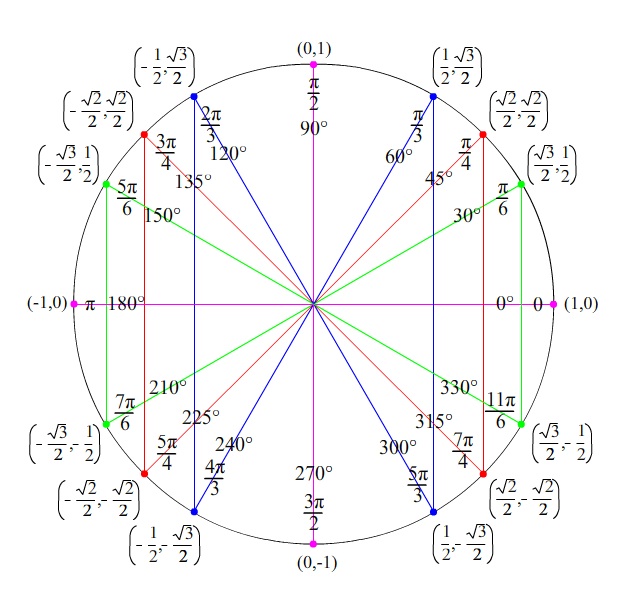
Triangle #1
 As we can see this triangle is formed by creating a 30 degree angle. To find our point on the circle, we must know the rules of these special right triangles. Each side of a triangle is labeled with a missing variable. For example, for this special right triangle, the hypotenuse is equivalent to 2n, the shortest side of the triangle is equivalent to n, and the longest side before the hypotenuse equals n radical 3. All we need to do is find the lengths of x and y of the triangle. All we have to do is set the hypotenuse (2n) equal to 1 and we can solve from there on. work is shown below.
Triangle #2
 The next special right triangle is created by a 45 degree angle. What we must know is that for this triangle the hypotenuse is equivalent to n radical 2, and the the two other sides are equivalent to n. Again all we must do is set the hypotenuse equal to 1 and solve. From there we can get the lengths of x and y, and eventually our point on the circle.
Triangle #3
 For this special right triangle, we can see that it is pretty much the same as the first triangle. Once we do this last one we can see that we have found three coordinates, and these coordinates correspond on a unit circle. This occurs throughout the unit circle except in the other quadrants we must face the signs of the coordinates. We can see that these three points are the same throughout the unit circle and how it relates to it.
Friday, February 1, 2013
Conic Section (Ellipse)
Conic Section
(Parabola)
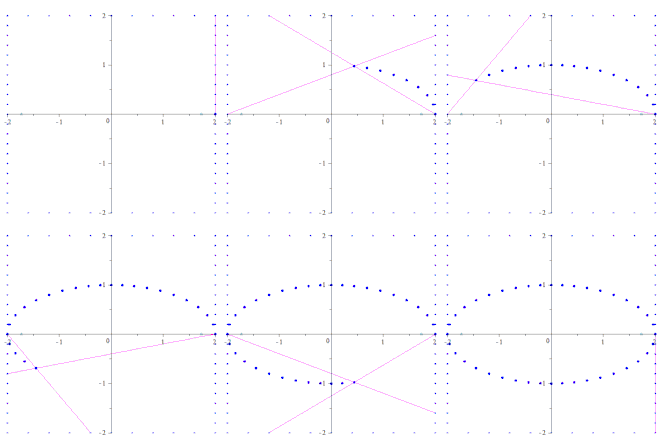
Q #1: What is the mathematical definition of this conic section and how does that definition play a role in the properties of the conic section and how it is shaped or formed?
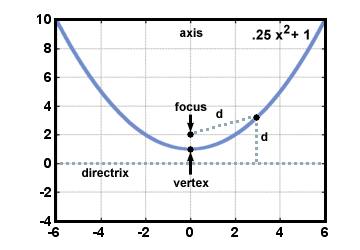

A #1: A parabola consists of a focus point, and a directrix. The focus is just a point inside the parabola, and the directrix is a fixed line beneath the parabola to help draw the curve. We can see that the length between the focus and directrix are equidistant when connected to touch the parabola. The eccentricity of a graph is usually 1. This is because if it were less, the curve would close in, and if it were greater, the parabola would eventually open wider and create a hyperbola. Click here to get a visual understanding of eccentricity.
Q #2: How does the focus (or foci) affect the shape of the conic section?
A #2: The distance of of the vertex to the focus point named as the term 'p'. The 'p' is equidistant to the length of the directrix connected to the graph. The distance of the focus and directrix to the vertex can fluctuate the size of the parabola. If the focus and directrix were farther away from the vertex, the graph would open much wider, otherwise it would be very thin. Click here to experiment with a live parabola.
Q #3: How do the properties of this conic section apply in real life?
A #3: Here we can see that the cables of the S.F.G.G. Bridge is very close to a parabola. It is shaped this way because the two towers holding the cables are very close to each other. Therefore, the cable must equally distribute its weight from the distance of one tower to the other. The closer it is to the tower, the higher the curve. This creates the shape of a parabola.

Citation
http://www.mathsisfun.com/geometry/eccentricity.html
https://www.google.com/images
http://www.intmath.com/plane-analytic-geometry/parabola-interactive.php
Wednesday, December 12, 2012
Monday, December 10, 2012
Subscribe to:
Posts (Atom)